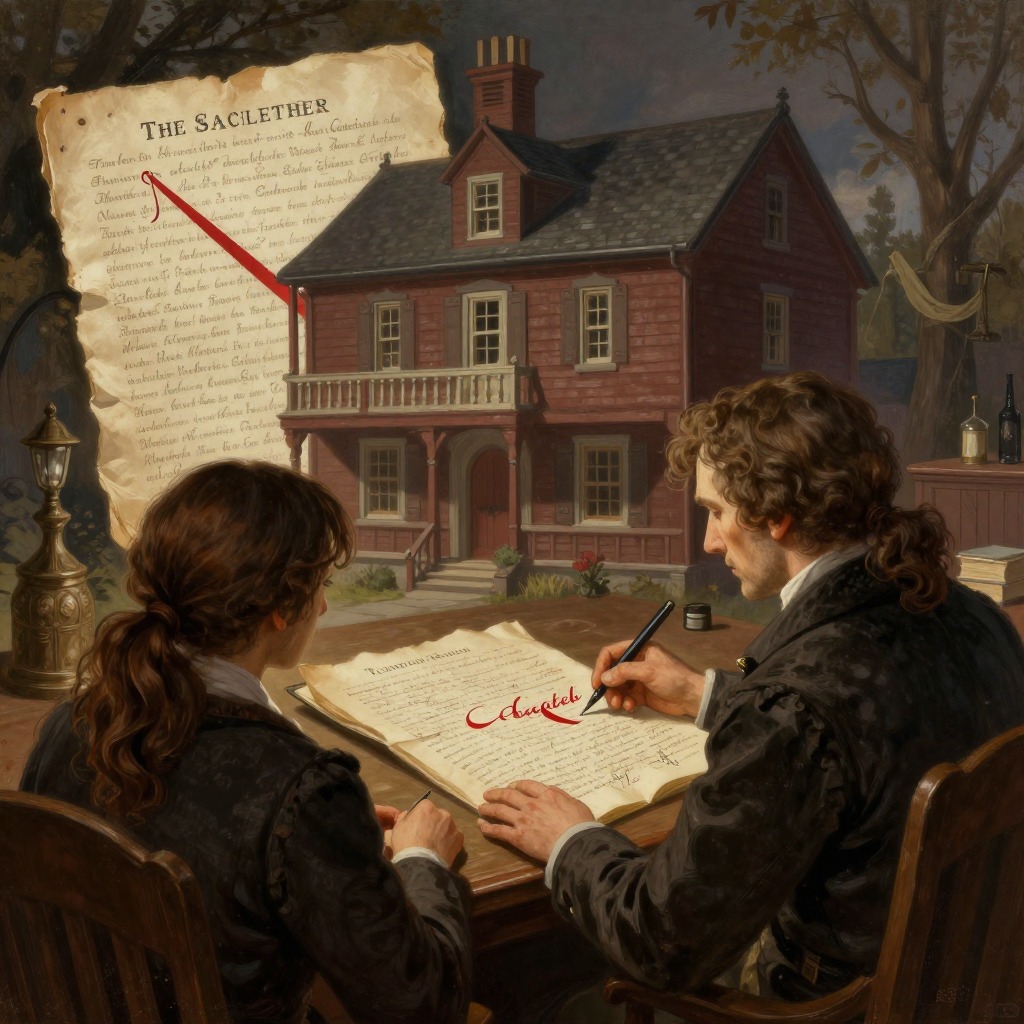
Old Manse
The Old Manse is the historic Concord, Massachusetts, residence where Nathaniel Hawthorne spent the first three years of his marriage, from 1842 to 1845, and which he evokes in the Custom-House introduction to The Scarlet Letter as the symbolic opposite of the Custom-House—a place of imaginative richness, domestic quiet, and literary productivity that he had left behind. The house itself, with its willow branches casting sunlight into a cheery little study, represents for Hawthorne a lost creative Eden, and its memory becomes the standard against which he measures the intellectual torpor of his subsequent years as a Surveyor of the Revenue.
Setting and Atmosphere
The Old Manse is described by Hawthorne as a place of "deep quietude" where he lived before his appointment to the Custom-House. Its most memorable feature is a "cheery little study" on the western side, where "the sunshine glimmered so pleasantly through the willow branches." This image of domestic tranquility and natural light stands in direct opposition to the cobwebbed, sand-strewn, and sunless rooms of the Salem Custom-House, which Hawthorne portrays as a sanctuary into which "womankind, with her tools of magic, the broom and mop, has very infrequent access." The Old Manse, by contrast, is associated with the feminine, the domestic, and the fertile—a space where literary imagination could flourish.
Hawthorne's Life at the Old Manse
Hawthorne lived at the Old Manse with his wife Sophia following their marriage in 1842. During this period he wrote many of the tales collected in Mosses from an Old Manse (1846), a title that directly references the house. In the Custom-House sketch, he recalls his time there as one of intellectual companionship with the "dreamy brethren of Brook Farm," the "subtle influence of an intellect like Emerson's," and "wild, free days on the Assabeth, indulging fantastic speculations, beside our fire of fallen boughs, with Ellery Channing." He also remembers "talking with Thoreau about pine-trees and Indian relics in his hermitage at Walden" and "growing fastidious by sympathy with the classic refinement of Hillard's culture." This constellation of Concord's transcendentalist circle—Emerson, Thoreau, Channing, and others—marks the Old Manse period as Hawthorne's most intellectually and socially engaged literary phase.
Contrast with the Custom-House
The Old Manse functions in the Custom-House sketch as the primary term of contrast with Hawthorne's later life as a public official. He writes that after leaving the Old Manse, "literature, its exertions and objects, were now of little moment in my regard. I cared not at this period for books; they were apart from me." The imaginative faculty that had been so active in the Old Manse study became, in the Custom-House, "a tarnished mirror" that "would not reflect, or only with miserable dimness, the figures with which I did my best to people it." The characters of his intended narrative "would not be warmed and rendered malleable by any heat that I could kindle at my intellectual forge." This creative paralysis is directly attributed to the change of environment: "So little adapted is the atmosphere of a Custom-house to the delicate harvest of fancy and sensibility." The Old Manse thus becomes the lost home of Hawthorne's literary self, a place whose "invigorating charm of Nature" used to give him "such freshness and activity of thought, the moment that I stepped across the threshold."
Narrative Significance
The Old Manse serves as more than a biographical setting; it is a structural device in the Custom-House introduction that establishes the stakes of Hawthorne's narrative frame. By contrasting the fertile literary life of the Old Manse with the sterile official life of the Custom-House, Hawthorne dramatizes his own struggle to recover his imaginative powers. The discovery of Surveyor Pue's manuscript and the scarlet letter itself occurs in the Custom-House, but the creative energy to transform that discovery into a tale only returns after Hawthorne is ejected from office and returns to his writing desk. The Old Manse, in this sense, represents not merely a past residence but a permanent standard of literary authenticity against which the Custom-House interlude is measured and found wanting. Its memory, preserved in the introductory sketch, becomes the guarantee that the tale of The Scarlet Letter was ultimately rescued from the deadening atmosphere of public office.